
A practical guide for Nigerian business owners choosing marketing support.
Most Nigerian business owners ask this question when they are ready to grow but unsure what a fair marketing budget looks like. The challenge is that many answers are either vague or based on Western pricing that does not reflect Nigerian business realities.
This guide gives you a practical answer: what marketers charge, what you should expect at each level, when to hire a freelancer versus an agency, and how to avoid paying for activity instead of business growth.
The Quick Answer
A realistic monthly range for digital marketing in Nigeria is:
| Level | Typical Monthly Rate |
| Beginner | ₦200,000+ |
| Intermediate | ₦₦500,000+ |
| Advanced / Senior | ₦750,000 and above |
These figures can apply to freelancers and in-house marketers. Agencies usually charge differently because they provide multiple specialists, tools, systems, reporting, and strategic oversight.
But price alone is not the real question. The better question is: what business result should this person or agency be accountable for?
Why Businesses Often Get This Wrong
Many businesses treat digital marketing as something simple: post on social media, run a few ads, boost the post, and get more followers. That mindset creates two common mistakes.
- They underpay, receive poor work, and conclude that digital marketing does not work.
- They pay a premium for an agency or marketer that looks busy but cannot connect their work to sales, leads, or revenue.
In both cases, the real problem is not necessarily the budget. It is the lack of clear expectations, tracking, and accountability. Marketing should not only be measured by how much work was done. It should be measured by whether the work moved the business forward.
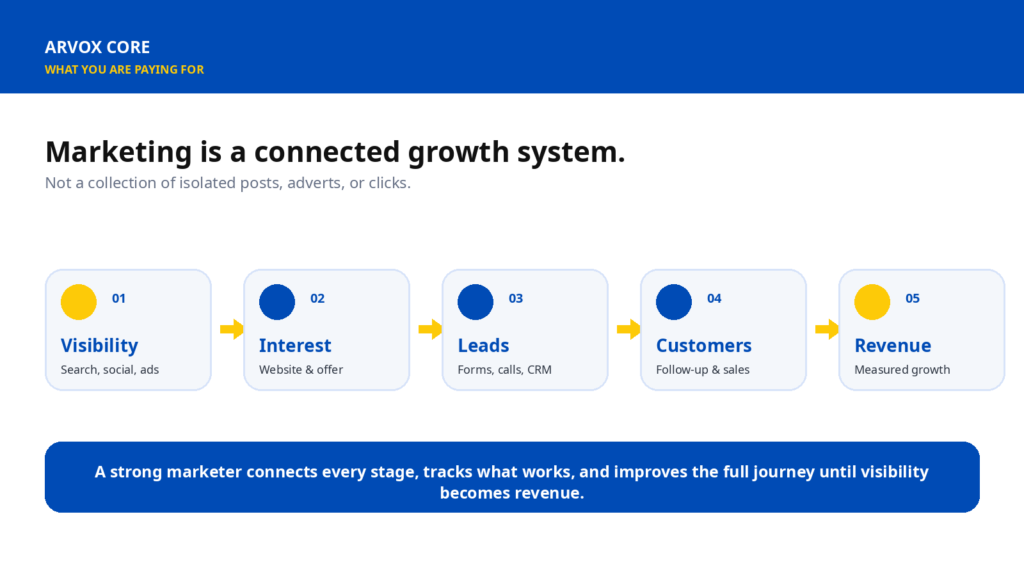
Marketing should connect visibility, conversion, follow-up, and revenue – not treat them as isolated activities.
What You Should Actually Be Paying For
There is a major difference between paying for deliverables and paying for outcomes.
A lower-level marketer may say: “I created 20 posts, launched Facebook ads, and got 2,000 clicks.”
A stronger marketer will say: “We reduced customer acquisition cost, increased qualified leads, improved conversion rates, and contributed measurable revenue.”
Both may be working. But only one is connecting marketing to business growth. Here is what separates a premium digital marketer from someone who simply runs ads or posts content.
1. Business Strategy
They understand the full business, not just the marketing channel. They think about your offer, pricing, target audience, customer journey, positioning, sales process, and growth goals before deciding what campaigns to run.
2. Revenue Attribution
They can help answer where leads come from, which campaigns produce sales, what it costs to acquire a customer, and which channels generate the best return.
3. Conversion Optimisation
They do not only focus on getting traffic. They improve what happens after people click through better landing pages, website experience, copywriting, offers, forms, follow-up systems, and conversion rates.
4. Marketing Systems
They build systems that continue working beyond a single campaign, including CRM setup, lead tracking, email automation, retargeting, lead nurturing, dashboards, and automation.
5. Multi-Channel Thinking
They understand how channels work together: search, social media, paid ads, email, content, influencers, and AI-powered search optimisation.
6. Data and Analytics
Every decision should be based on evidence: website traffic, conversion rates, lead quality, funnel performance, campaign data, customer behaviour, and revenue impact.
7. Technical Capability
Modern marketing often requires Google Analytics 4, Google Tag Manager, Meta Pixel, server-side tracking, CRM tools, automation platforms, APIs, and basic website knowledge.
8. Proven Results
They should show evidence of meaningful improvement, such as more qualified leads, lower cost per lead, higher conversion rates, stronger organic traffic, or improved return on ad spend.
9. Commercial Thinking
They care about profit, customer retention, revenue growth, customer lifetime value, and scalability – not only likes, reach, impressions, or followers.
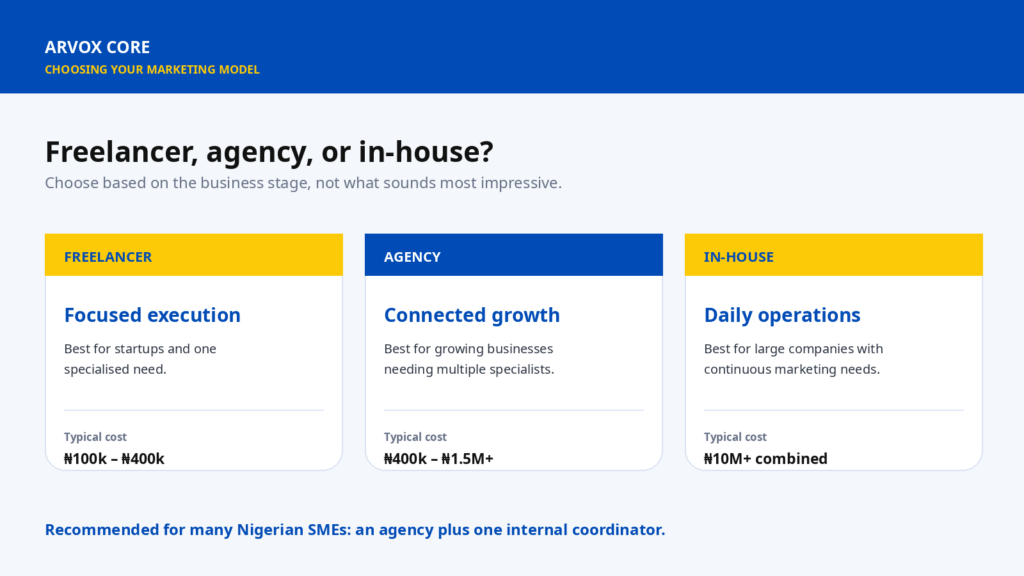
The right model depends on your growth stage, the depth of expertise needed, and how central marketing is to revenue.
Agency vs. Freelancer vs. In-House: A Framework for Nigerian Businesses
There is no single best hiring option for every Nigerian business. The right choice depends on your current stage, revenue, team, and how important marketing is to your growth.
| Business Stage | Best Fit | Typical Monthly Cost | Why |
| Startup (₦0-₦5M/month) | Freelancer | ₦100k – ₦400k | Keep costs lean while validating offers |
| Growing (₦5M-₦50M/month) | Small agency or hybrid | ₦400k – ₦1.5M | Needs broader expertise than one person can provide |
| Established SME (₦50M-₦300M/month) | Agency + Internal lead | ₦1.5M – ₦5M+ | Needs systems, reporting, content, paid media, and strategy |
| Large company | In-house team + Agency | ₦10M+ combined | Needs full-time execution and outside specialists |
When a Freelancer Makes Sense
- Your budget is limited.
- You need one specific skill.
- You are testing a new channel.
- Marketing is not yet a major growth engine.
- You need focused support with paid ads, SEO, design, content, or website updates.
A good freelancer should be specialised. Be careful with anyone claiming to be an expert in branding, SEO, paid ads, design, social media, email marketing, websites, automation, and analytics all at once.
When an Agency Makes Sense
An agency is often the better choice when marketing directly affects revenue and you need strategy, paid advertising, content, creative design, SEO, website conversion, email marketing, analytics, and automation working together.
While some agencies like Arvox Core provide an in-house team that handles the full marketing function, (strategy, content, paid ads, SEO, website optimisation, email marketing, and analytics). Others may only offer one or two services.
When In-House Makes Sense
An in-house team works best when marketing is a daily operational function. This is common for large e-commerce companies, banks, telecoms, media businesses, and fast-growing companies with heavy content and campaign needs. However, costs rise quickly once you require a manager, designer, content creator, ads specialist, SEO specialist, editor, CRM specialist, and analyst.
For many Nigerian SMEs, the strongest model is often an agency plus one internal marketing coordinator. The internal person understands the business, customers, approvals, and sales team. The agency supplies strategy and specialist execution.
Two Real Situations Where Businesses Get It Wrong
Case One: Paying Premium Fees for Busy Work
A mid-sized real estate company hired an agency on a substantial monthly retainer. The agency delivered daily posts, polished graphics, weekly reports, boosted posts, and monthly meetings filled with marketing language.
Everything looked professional. But there was no proper lead tracking, CRM integration, conversion reporting, or clear definition of success. After six months, the company could not answer one simple question: which marketing activities actually generated closed sales?
They were not paying for growth. They were paying for activity.
Case Two: Hiring the Cheapest Option
A professional services company hired a low-cost freelancer to run Meta ads. The ads targeted a broad audience, sent people to the homepage, had weak tracking, and were not optimised after launch. The business received clicks and likes but very few qualified enquiries.
Later, a more experienced marketer reviewed the setup and found a weak offer, a non-converting landing page, incorrect conversion settings, no retargeting, and campaigns optimised for traffic instead of leads. Once these issues were fixed, the same platform started generating qualified enquiries.
Cheap marketing is not always cheaper. It can simply take longer to fail visibly.
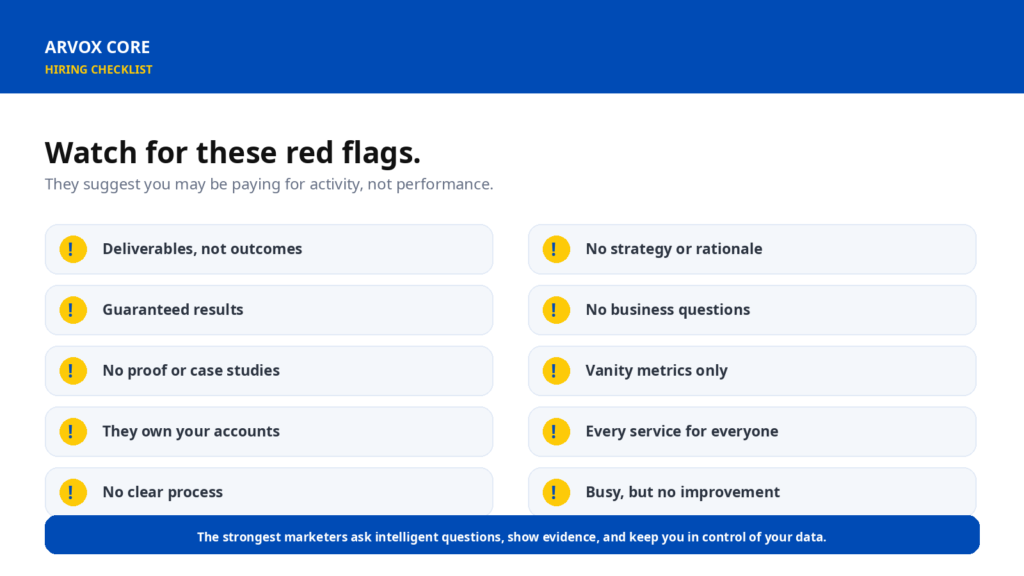
A credible marketing partner should connect their work to business goals, share proof, and give you access to your own assets.
10 Red Flags Before You Hire a Marketer
1. They talk only about deliverables
“30 posts per month” is not a business outcome. Ask how their work will affect leads, conversion rates, customer acquisition cost, sales, or revenue.
2. They cannot explain their strategy
A strong marketer should explain why they recommend each activity and how it supports your goal. “Because it is trending” is not a strategy.
3. They guarantee unrealistic results
Be careful with promises such as “We will rank you number one on Google” or “We guarantee 10x ROI.” Good marketers make informed projections, not careless guarantees.
4. They do not ask about your business
They should ask about your audience, pricing, margins, sales process, customer journey, goals, current marketing, and conversion rates before proposing a solution.
5. They cannot show evidence
They do not need celebrity clients, but they should show case studies, dashboards, before-and-after results, client references, or documented performance.
6. They report only vanity metrics
Likes, reach, impressions, and followers can be useful, but they are not enough. Ask how those metrics connect to enquiries, customers, sales, or revenue.
7. They control assets that should belong to you
Your business should own its ad accounts, analytics accounts, website data, CRM, tracking pixels, and marketing assets.
8. They sell every service to every client
Not every business needs SEO, Meta ads, TikTok, email marketing, influencers, and website redesign at the same time. A strong marketer solves the real problem first.
9. They have no process
Experienced marketers usually follow a clear process: audit, strategy, setup, execution, measurement, optimisation, and reporting.
10. They are always busy but results do not improve
Months pass, but leads are not improving, sales are flat, and conversion rates have not moved. Being busy is not the same as being effective.
How to Hire Right: Questions to Ask Before Signing
Do not hire based only on certifications, confidence, or a polished proposal. Ask questions that reveal how they think.
“How would you grow our business?”
A strong marketer asks questions before giving solutions. They want to understand your ideal customer, current acquisition channels, average sale value, conversion gaps, sales process, and goals.
“Show me a campaign you worked on.”
Ask what the objective was, how they approached it, what happened, what results they achieved, and what they would do differently now. Evaluate their thinking, not just screenshots of ad spend.
“Which metrics will you be accountable for?”
Look for qualified leads, cost per acquisition, conversion rate, return on ad spend, and revenue influenced by marketing.
“If you had only 90 days, what would you do first?”
A capable marketer will usually audit current marketing, fix tracking and analytics, improve the offer or customer journey, improve the website or landing page, launch focused campaigns, and optimise based on data.
“Tell me about a campaign that failed.”
Good marketers can explain what went wrong, what they changed, and what they learned. Anyone who claims they have never failed should make you cautious.
Before signing, request:
- Two or three relevant case studies
- Client references
- A sample report or dashboard
- A sample strategy or audit
Rather than committing to a 12-month contract immediately, begin with a paid discovery phase. This could include an audit, a 90-day growth plan, defined KPIs, and recommended budget allocation. It allows you to evaluate how they think before committing long term.
The Nigeria-Specific Factors That Affect Pricing
Exchange Rate Volatility
Many essential marketing tools are priced in dollars, including SEO software, AI tools, analytics platforms, automation systems, design tools, CRM platforms, and advertising technology. When the naira weakens, agency costs increase even when the scope of work remains the same.
Talent Scarcity
Experienced marketers who consistently deliver measurable results are rare. Many work remotely for international companies and earn in foreign currencies. Nigerian businesses often need to pay competitively to attract and retain quality talent.
Software and Operating Costs
Agencies do not only pay salaries. They also invest in tools for reporting, analytics, design, CRM, project management, content, automation, SEO, and client communication.
Payment Structures
Most Nigerian businesses prefer monthly retainers. However, agencies may require an upfront deposit, a separate advertising budget, milestone payments for major projects, or payment for strategy and discovery before execution begins.
Business Maturity
Many SMEs still see marketing as an expense rather than a growth function. This creates pressure to reduce fees even when the business expects aggressive results. Both sides need realistic expectations of what the budget can achieve.
“Marketing Is Too Expensive”: What That Mindset Can Cost
When a business chooses the cheapest option or tries to do everything internally without the right expertise, it may not actually be saving money. It may simply be delaying an investment.
The cost often shows up as:
- Months of slow growth
- Wasted advertising spend
- Missed market share
- Weak brand perception
- Poor-quality leads
- Low conversion rates
- Lost time while competitors move faster
That said, not every business needs an agency immediately. If your budget is genuinely tight, doing some marketing yourself can be reasonable. But it should be temporary and intentional, with a plan to bring in stronger expertise when growth demands it.
The real cost is not always what you spend on marketing. Sometimes it is the revenue, market share, and time lost because your marketing was ineffective.
The investment test: clear goals, measurable KPIs, owned data, evidence, and ongoing optimisation.
Final Advice
Do not hire the cheapest marketer. Do not automatically hire the most expensive one either. Hire the person or agency that understands your business, asks intelligent questions, has a clear process, and can show evidence of creating measurable value.
Ask for proof, not promises. Pay for outcomes, not activity. Start with a focused engagement, define clear KPIs, and expand the relationship when results justify it.
The right marketer will not only help you spend your marketing budget. They will help you turn visibility into measurable business growth. And when they consistently create more value than they cost, they are not expensive. They are one of the strongest investments your business can make.
Growth Starts With Clarity
Ready to Turn Visibility Into Revenue?
You do not need more marketing activity. You need a strategy that attracts the right audience, converts interest into qualified leads, and delivers measurable growth.
Book a free growth audit with ARVOX CORE and discover where your marketing is losing opportunities — and what to fix first.
Book Your Free Growth Audit
Complete the form below and our team will get back to you.